A three-day Erasmus+ workshop prepares students to document the Old City of Nablus and tell its story
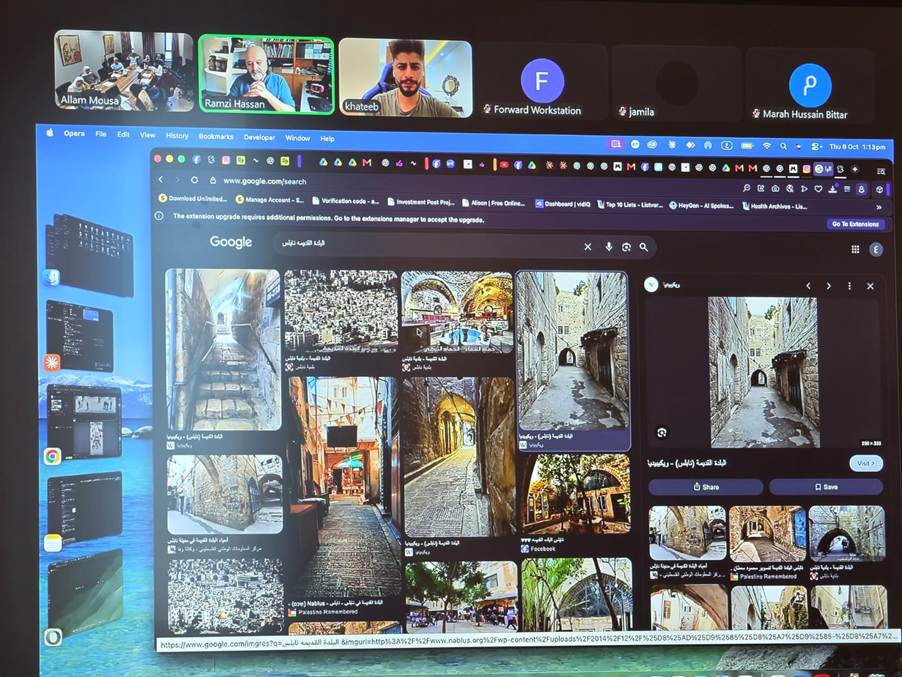
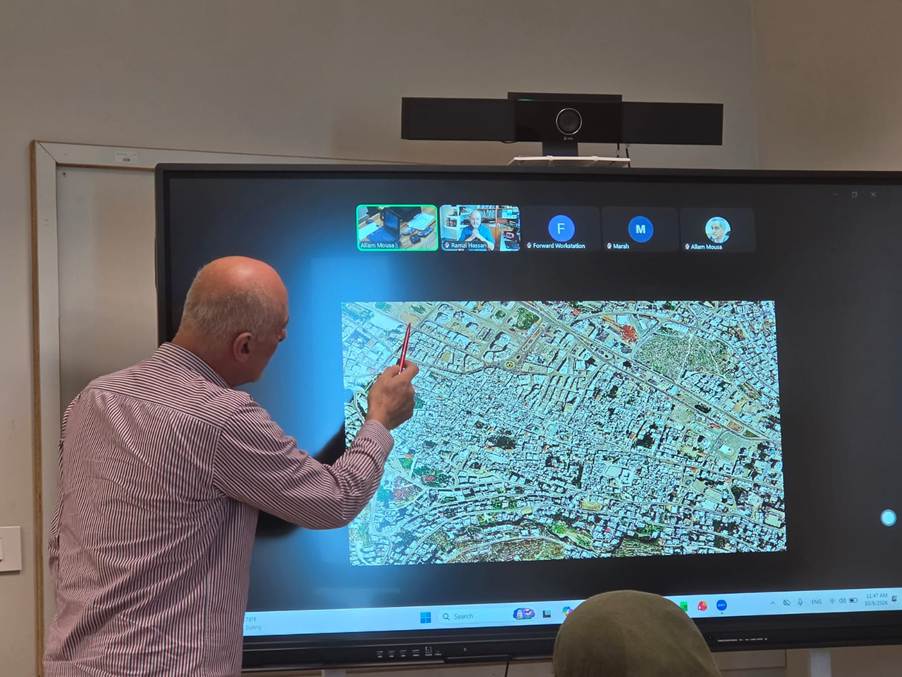
Nablus, 8 October 2026 – An-Najah National University hosted the first technical training workshop of the FORWARD project, funded by the European Union’s Erasmus+ programme, from 6 to 8 October 2026. The workshop, “Digital Documentation, AI and Immersive Storytelling for Urban Resilience”, was designed and delivered online by Dr. Ramzi Hassan, Head of the Virtual Reality Laboratory at the Norwegian University of Life Sciences (NMBU), and facilitated on site by An-Najah. Twelve participants, most of them architectural engineering students at An-Najah, took part and worked in groups on campus.
The trainer and the local team. Dr. Ramzi Hassan, an expert in VR and 3D visualisation for landscape architecture and urban planning, prepared the full programme: four lectures, live demonstrations and step-by-step guides for each tool. Each morning he presented the methods and demonstrated the equipment online, then reviewed the groups’ results and answered their questions. At An-Najah, Dr. Zahraa Zawawi, the university’s FORWARD coordinator, opened the workshop and introduced the project and the team. Prof. Allam Mousa, An-Najah’s AI and VR lead, facilitated the training on site for the three days and guided the groups in their practical work, using equipment prepared in advance by the university.
Day 1 – Reality capture. Dr. Hassan opened the training with a lecture on reality capture and 3D visualisation, and with live demonstrations of the XGRIDS PortalCam, which uses AI-powered 3D Gaussian Splatting, and the Polycam mobile app. Participants then scanned buildings and features on the An-Najah campus. The models were processed in the lab, and some of them have been published online.
Day 2 – Immersive capture and storytelling. After presenting their first models to Dr. Hassan for feedback, the groups moved on to 360° media and VR. They recorded 360° photos and videos with Insta360 cameras, linked the panoramas into simple virtual tours, and explored the results in VR headsets.
Day 3 – AI and heritage. In his lecture on AI-assisted historical reconstruction, Dr. Hassan showed what these tools can do, and why documented evidence must be kept apart from speculative reconstruction. He also introduced the group project. Three guest speakers then took part: architect Naseer Arafat introduced the Old City of Nablus; Mr. Abdulrahman Alkhateeb spoke about using AI to tell the stories of Palestine, its history and heritage; and Mr. Paolo Tosolini shared his experience in capturing 3D Gaussian Splatting models.
Next steps. The groups will now work on projects about the Old City of Nablus, using the methods learned in the workshop. They are supervised by Dr. Ramzi Hassan (NMBU) on digital methods, together with Dr. Zahraa Zawawi on the architectural side and Prof. Allam Mousa on the technical side at An-Najah National University.