On 24 September 2026, the FORWARD project convened its second Stakeholders’ Workshop, bringing together academic institutions, public authorities, utility operators, and civil society organisations from Palestine and Ukraine for a focused, online working session. Where the project’s first stakeholder workshop gathered broad input on training priorities, this second session took a more concrete approach: examining real, specific conditions on the ground in both countries and using them to directly shape the practical case studies at the heart of FORWARD’s training curriculum.
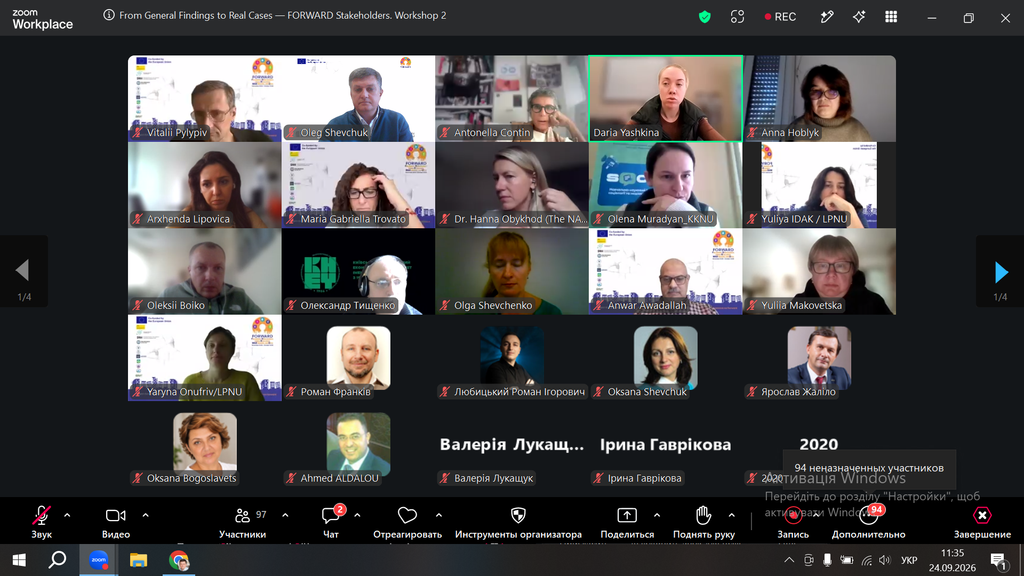
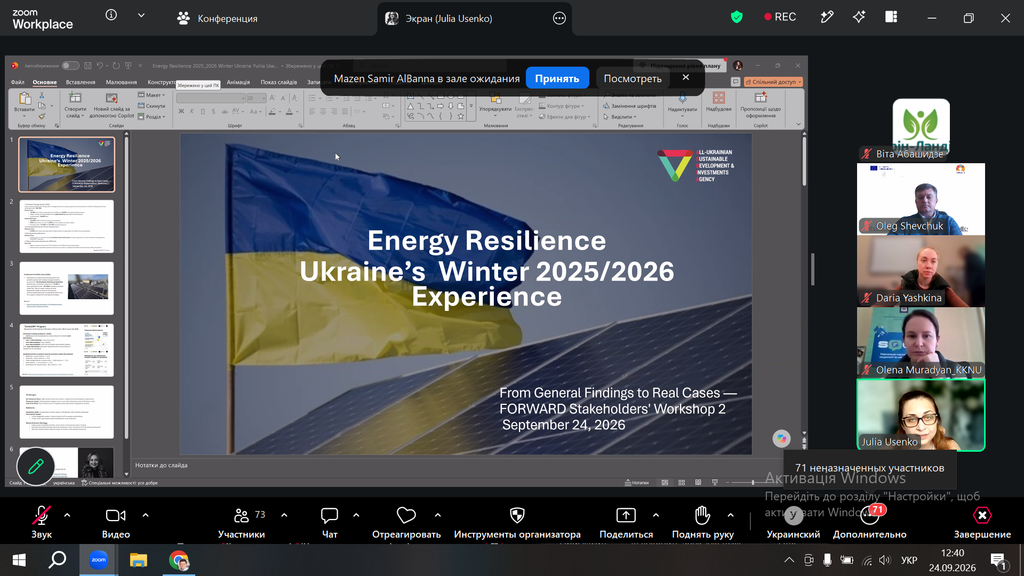
The day opened with a welcome from KNEU and a short introduction to the FORWARD project, before turning to the heart of the session: the presentation of two Anchor Cases — real, bounded contexts that ground everything the project builds.
What is an Anchor Case?
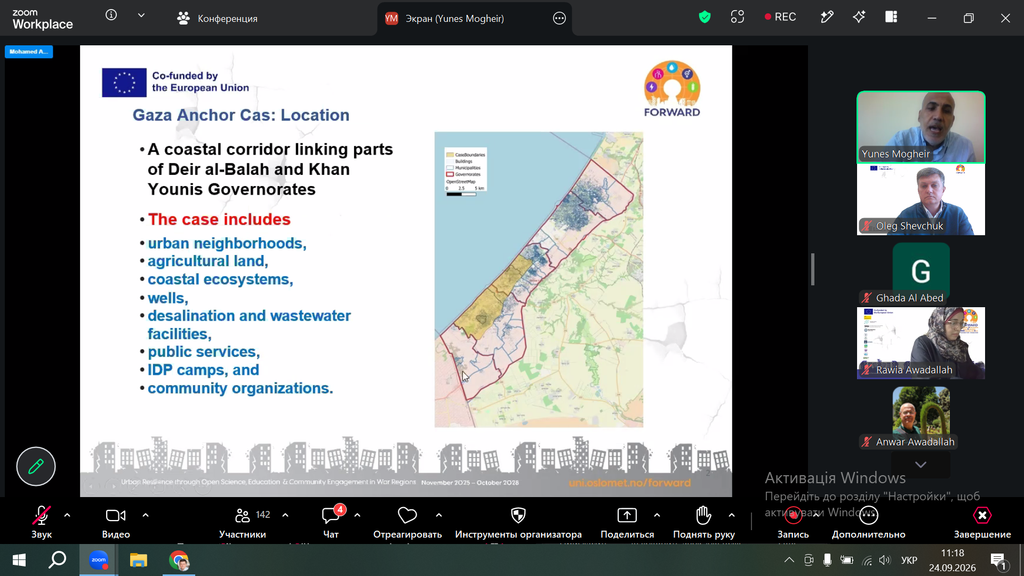
For Palestine, the Anchor Case is the Gaza Urban Resilience Living Lab (GUR-Lab) — a roughly 63 km² coastal urban corridor spanning parts of Deir al-Balah and Khan Younis Governorates, encompassing neighbourhoods, agricultural land, coastal ecosystems, water and desalination infrastructure, and displacement camps. Deliberately, the case is framed to span every phase a community moves through — active conflict, fragile truce, early recovery, and reconstruction planning — since a single site can hold all of these at once.
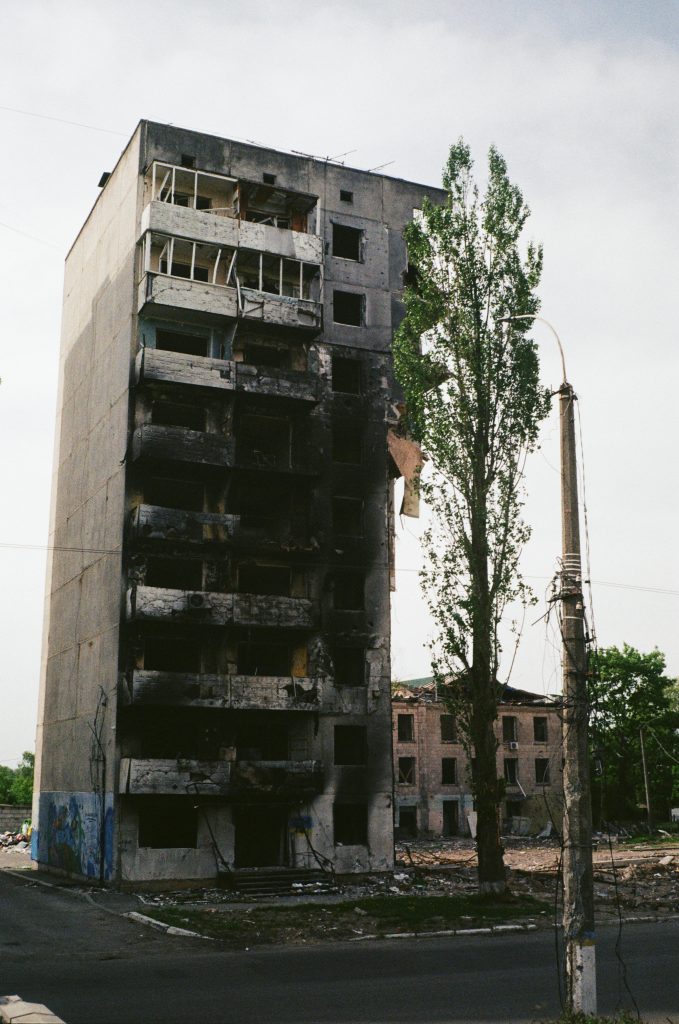
For Ukraine, the Anchor Case examines the winter 2026 blackouts affecting cities nationwide, with the most severe impact concentrated in Kyiv, Kharkiv, Dnipro, and Odesa. The scale is sobering: attacks on energy infrastructure were reported across at least 17 regions and the capital; in Kharkiv, a single wave of strikes cut power to roughly 80% of the city in freezing conditions of around –14°C, with 40% of residents still without electricity the following day; in Kyiv, repeated strikes left more than 1,100 buildings without restored heating for the rest of the winter, with indoor temperatures in some apartments falling as low as 2–8°C.
Both Anchor Cases exist for the same reason: to ground FORWARD’s training content in one real, integrated situation — not six separate, disconnected topics.
Participants worked in two parallel sessions — one focused on the Palestinian context, facilitated by An-Najah National University (ANNU), and one focused on Ukraine, structured around five thematic discussions with invited speakers and facilitated by Kharkiv National University of Radio Electronics (KKNU) — before reconvening to share findings across both groups.
What emerged from the Palestinian session
The Palestinian session began by briefly introducing the full range of practical case studies developed across all five sectors — water, energy, food, housing, and gender. A number of these were then presented in greater depth, including cases on groundwater sustainability and aquifer recovery, GIS-based mapping of displacement and water infrastructure needs, local seed initiatives, electrical load assessment and network recovery planning, solar power integration, the transition of school shelters back to educational use, coastal shelter site safety, and — notably — safe lighting and energy access as a specific gender-related concern. Once these examples had been presented, the floor was opened to all participants, who were invited to comment not only on the individual cases but on the Palestine Anchor Case as a whole.
Discussions grounded in current conditions in Gaza were candid about how far current conditions fall short. As the session’s closing conclusions put it plainly: current shelter conditions do not meet the living and humanitarian needs of displaced people, nor do they hold up through summer or winter — the clear call was for a gradual shift from emergency response toward genuine recovery. Participants spoke about the importance of restoring public facilities specifically so that residents feel the situation has changed, and so hope has somewhere to take hold.
Water security emerged as comprehensive and urgent enough to warrant its own deep body of knowledge, with decentralisation identified as the clearest path forward. On energy, the emphasis fell on practical, hands-on skills — solar system design and configuration, and proper load estimation for generators — rather than theory alone. On food, participants pointed to the value of combining traditional agricultural knowledge with newer urban and peri-urban growing methods.
Gender was raised as a thread running through everything else: psychological support was described as necessary across all parts of society, and participants specifically called for greater support of youth participation — especially among young women — as part of building resilience going forward.
Throughout, participants pointed outward as well as inward — drawing explicit comparisons to post-earthquake recovery in Türkiye as a model worth learning from, and stressing that any case study should give people real, immediately usable knowledge, not just documentation. As the closing conclusions summarised it: the case material was found to be practical, useful, and comprehensive — exactly what the training content needs to be built on.
What emerged from the Ukrainian session
The Ukrainian session opened with a reframing that shaped the entire discussion: participants argued that what is commonly called a “blackout” should more accurately be described as a temporary restriction on electricity supply — a distinction that matters, since it shifts the goal from simply restoring damaged infrastructure toward building a system able to adapt and keep functioning under sustained wartime pressure. This resilience, participants noted, depends on five interconnected dimensions: infrastructure, operational capacity, resource availability, institutional stability, and community-level preparedness.
That same push toward smarter, more resilient design ran through the housing discussion, where participants proposed a concept of “distributed compactness” — medium-rise, polycentric urban planning that avoids the vulnerability of a single critical node, paired with expanded use of underground space for shelters and storage. Rising shelter demand in cities like Kyiv, participants noted, already shows that current capacity isn’t sufficient.
On water, participants distinguished two very different kinds of disruption: a single building losing power to its pumps, versus a city-wide failure affecting entire pumping stations — each requiring a different scale of response, from building-level backup power to shared local water storage co-financed by residents.
Food security discussions highlighted how small-scale farms are being squeezed by high energy costs, with growing interest in solar power and other renewable solutions — supported in some cases by grant funding already in use. And on gender, participants were clear that wartime power restrictions don’t create new inequalities so much as intensify existing ones: the disproportionate burden of care work — childcare, meal preparation, hygiene, supporting elderly or vulnerable family members — becomes significantly harder without reliable electricity, heating, or connectivity, reinforcing the need for safe spaces that offer real practical support, not just shelter.
What’s next
Findings from both country sessions are now being consolidated into FORWARD’s Knowledge and Capacity Gap Matrix and Practical Case-Study Template, feeding directly into the module development process now underway across all six training modules — Open Science, Water Management, Energy Sustainability, Food Security, Housing and Sheltering, and Gender Equity.
This event was made possible by the participation of academic, institutional, and civil society partners from Palestine and Ukraine, and coordinated by KNEU, ANNU, and KKNU.